Tudor things, part 2
Feb. 22nd, 2014 11:47 pm![[personal profile]](https://www.dreamwidth.org/img/silk/identity/user.png) mandie_rw
mandie_rwHaving some nice mulled wine right now, after a madly busy evening at work, which will definitely absolutely keep me awake (and coherent) while I write this post.
*yawn*
Wish I'd written a proper post about it when I'd made my first Tudor dress, since none of my ideas have really changed - but I didn't, so here we are.
I also wish I could remember where I first read the suggestion that Tudor ("Tudor" hereafter referring approximately to the reign of Henry VIII) gowns closed in the center-front, but I didn't note it down. So all I can say is that it's not my original idea, and there's no concrete proof of it...but I think there's some quite convincing evidence for it.
I know many people make their Tudor gowns back-lacing, but since later Elizabethan gowns seem to be front-closing (which I suddenly realized I could be hallucinating, but if so it's an assumption I've been laboring under for ten years, so let's just forge ahead), it makes no sense for everybody's gowns to suddenly switch from back to front closing, just because they crowned Elizabeth.
So, here's a sketch from, uhh, about 1535 or so.

Front AND back views, I love it! Okay, what's notable here - besides that we're not seeing a farthingale yet? Definitely don't see a back closing. (Though I do see what looks interestingly like a tiny en forreau 18thc back! I'm sure it's not, but...huh.) It's been suggested to me that the veil is hiding a side/side-back closure, which is possible, and I can't discount it.
(Side-back closures are basically evil, though, and I refuse to make one on my dress.)
Then we've got two versions of a portrait of the More family, with a lot of pregnant women.


I'm not sure of the year, but I think it's safe to assume it's before 1535 (since Thomas More was beheaded that July...). Between the two versions, one can get a pretty fair idea of at least the basics of the clothing. The pregnant women have gown bodices that lace open over their big bellies; the other women appear to have closed-front bodices. Since maternity wear (that is, clothing specially designed for and only to be worn by a woman while pregnant) is a relatively recent phenomenon, I don't think it's too much of a leap to suppose that these front-lacing gowns are not specifically designed to be worn only by pregnant women.
(I know there are examples here and there of maternity clothes, like the 18thc waistcoat/jacket/petticoat ensemble in Colonial Williamsburg's collection, but they're the exception, not the rule. Most women would simply have adapted their existing wardrobe to the constant fluctuation of their body's size. Ack. Let's all give thanks now for living in the twenty-first century and having children when and if we want...)
Anyway. So, it seems plausible, at least, that these gowns actually laced closed at the center front, and were usually covered by a stomacher-type piece of fabric. And then there's THE Holbein portrait of Jane Seymour as queen.

If you look in very closely to the right side of her bodice, you'll see a row of tiny gold dots running vertically down to the waist. Pin heads? That's my guess!
Later ETA: More pins!! http://www.pinterest.com/pin/430938258066819031/
So, basically, that's why I have made and will continue to make my Tudor bodices front-lacing under a stomacher. Also because front closing gowns are Just Better when you have to dress yourself!
While we're talking about bodices...let's talk about corsets! Or, rather, pairs of bodies. Or lack thereof. Most research dated within the past ten years or so seem to agree that there is "no evidence that there were separate boned bodies (corsets) at this point. These do not appear in wardrobe accounts until well into Elizabeth's reign." (from a very excellent overview of Tudor fashion, called Tudor Lady's Ensemble of 1545) Mode Historique's PDF "Bodies, Stays, and Corsets -- A Very Preliminary Report" goes into more detail on this.
Basically, I don't want to wear my effigy corset with this dress, is what I'm saying. I corded the bodice of the kirtle for my first Tudor dress, and I was quite happy with how that worked out for the earlier c1530s look - but by the 1540s you have the farthingale and a much more conical torso. Buckram, cardboard, and pasteboard are referenced in period (a bit later I believe, but sounds plausible), and Norah Waugh mentions a front "busc" in Corsets and Crinolines, though I do take that with a grain of salt as she's referencing the later Pfaltzgrafin pair of bodies there, which are late 16th-early 17thc.
I believe I can wrangle an acceptable shape with only a stiffened kirtle bodice again, but some experimentation will be in order!
Anything else of importance before I cease being coherent altogether? Oh, yes, the French hood! Essentially, Mode Historique's research on the subject makes perfect sense to me, and while the headdress composed of three pieces can't be definitely proven, there is considerably less evidence that they were made in one piece in that buckram crescent shape. Really, go read the article!
Plus, those crescent things are woobly.
My old hood, again, is an earlier style than I'll be doing with the Katherine Parr dress, but it's made of the three pieces and would, I suspect, stay on my head in a hurricane. For the 1540s I am going to try and build up the hair a bit more for more height (hello fake braid!), but it'll still follow the coif/paste/hood construction.
And with that, I think I'm completely done being coherent. Let's hit post and see if anybody can follow it! (Seeing as I've just now finished editing it at quarter to two in the morning...I'm having doubts.)
*yawn*
Wish I'd written a proper post about it when I'd made my first Tudor dress, since none of my ideas have really changed - but I didn't, so here we are.
I also wish I could remember where I first read the suggestion that Tudor ("Tudor" hereafter referring approximately to the reign of Henry VIII) gowns closed in the center-front, but I didn't note it down. So all I can say is that it's not my original idea, and there's no concrete proof of it...but I think there's some quite convincing evidence for it.
I know many people make their Tudor gowns back-lacing, but since later Elizabethan gowns seem to be front-closing (which I suddenly realized I could be hallucinating, but if so it's an assumption I've been laboring under for ten years, so let's just forge ahead), it makes no sense for everybody's gowns to suddenly switch from back to front closing, just because they crowned Elizabeth.
So, here's a sketch from, uhh, about 1535 or so.
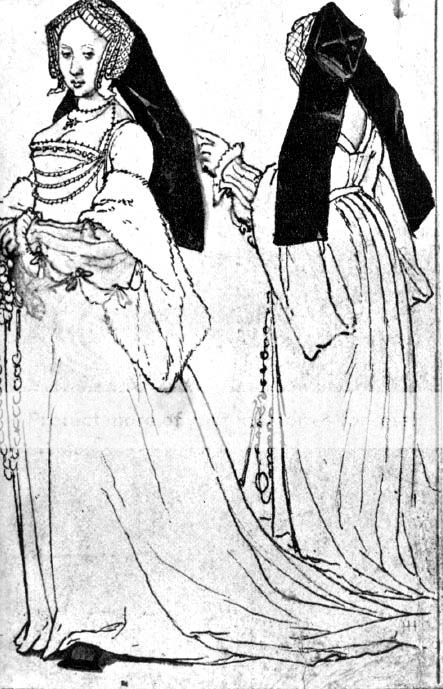
Front AND back views, I love it! Okay, what's notable here - besides that we're not seeing a farthingale yet? Definitely don't see a back closing. (Though I do see what looks interestingly like a tiny en forreau 18thc back! I'm sure it's not, but...huh.) It's been suggested to me that the veil is hiding a side/side-back closure, which is possible, and I can't discount it.
(Side-back closures are basically evil, though, and I refuse to make one on my dress.)
Then we've got two versions of a portrait of the More family, with a lot of pregnant women.


I'm not sure of the year, but I think it's safe to assume it's before 1535 (since Thomas More was beheaded that July...). Between the two versions, one can get a pretty fair idea of at least the basics of the clothing. The pregnant women have gown bodices that lace open over their big bellies; the other women appear to have closed-front bodices. Since maternity wear (that is, clothing specially designed for and only to be worn by a woman while pregnant) is a relatively recent phenomenon, I don't think it's too much of a leap to suppose that these front-lacing gowns are not specifically designed to be worn only by pregnant women.
(I know there are examples here and there of maternity clothes, like the 18thc waistcoat/jacket/petticoat ensemble in Colonial Williamsburg's collection, but they're the exception, not the rule. Most women would simply have adapted their existing wardrobe to the constant fluctuation of their body's size. Ack. Let's all give thanks now for living in the twenty-first century and having children when and if we want...)
Anyway. So, it seems plausible, at least, that these gowns actually laced closed at the center front, and were usually covered by a stomacher-type piece of fabric. And then there's THE Holbein portrait of Jane Seymour as queen.
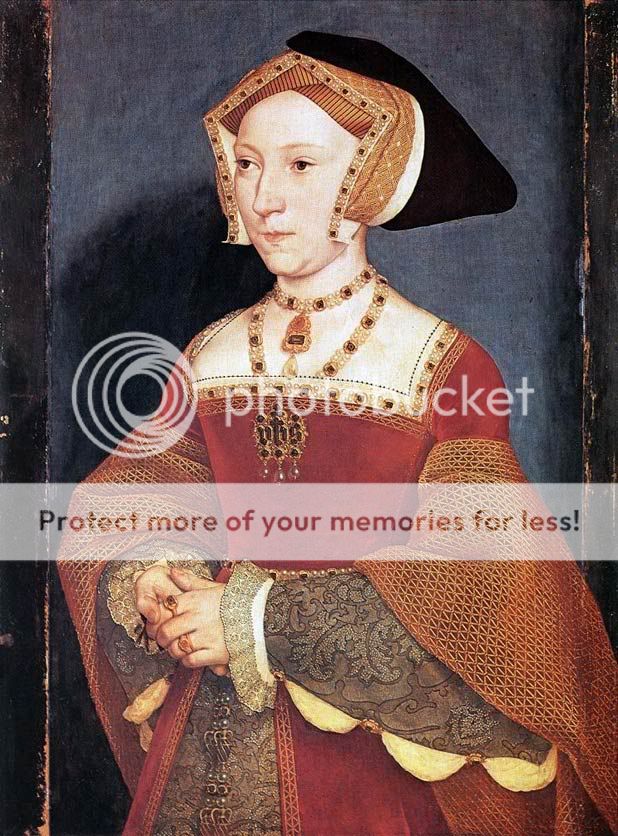
If you look in very closely to the right side of her bodice, you'll see a row of tiny gold dots running vertically down to the waist. Pin heads? That's my guess!
Later ETA: More pins!! http://www.pinterest.com/pin/430938258066819031/
So, basically, that's why I have made and will continue to make my Tudor bodices front-lacing under a stomacher. Also because front closing gowns are Just Better when you have to dress yourself!
While we're talking about bodices...let's talk about corsets! Or, rather, pairs of bodies. Or lack thereof. Most research dated within the past ten years or so seem to agree that there is "no evidence that there were separate boned bodies (corsets) at this point. These do not appear in wardrobe accounts until well into Elizabeth's reign." (from a very excellent overview of Tudor fashion, called Tudor Lady's Ensemble of 1545) Mode Historique's PDF "Bodies, Stays, and Corsets -- A Very Preliminary Report" goes into more detail on this.
Basically, I don't want to wear my effigy corset with this dress, is what I'm saying. I corded the bodice of the kirtle for my first Tudor dress, and I was quite happy with how that worked out for the earlier c1530s look - but by the 1540s you have the farthingale and a much more conical torso. Buckram, cardboard, and pasteboard are referenced in period (a bit later I believe, but sounds plausible), and Norah Waugh mentions a front "busc" in Corsets and Crinolines, though I do take that with a grain of salt as she's referencing the later Pfaltzgrafin pair of bodies there, which are late 16th-early 17thc.
I believe I can wrangle an acceptable shape with only a stiffened kirtle bodice again, but some experimentation will be in order!
Anything else of importance before I cease being coherent altogether? Oh, yes, the French hood! Essentially, Mode Historique's research on the subject makes perfect sense to me, and while the headdress composed of three pieces can't be definitely proven, there is considerably less evidence that they were made in one piece in that buckram crescent shape. Really, go read the article!
Plus, those crescent things are woobly.
My old hood, again, is an earlier style than I'll be doing with the Katherine Parr dress, but it's made of the three pieces and would, I suspect, stay on my head in a hurricane. For the 1540s I am going to try and build up the hair a bit more for more height (hello fake braid!), but it'll still follow the coif/paste/hood construction.
And with that, I think I'm completely done being coherent. Let's hit post and see if anybody can follow it! (Seeing as I've just now finished editing it at quarter to two in the morning...I'm having doubts.)

![[identity profile]](https://www.dreamwidth.org/img/silk/identity/openid.png)
no subject
Date: 2014-02-23 01:38 pm (UTC)no subject
Date: 2014-02-24 05:14 am (UTC)no subject
Date: 2014-02-23 02:11 pm (UTC)no subject
Date: 2014-02-24 05:33 am (UTC)no subject
Date: 2014-02-24 01:35 pm (UTC)no subject
Date: 2014-02-23 02:22 pm (UTC)no subject
Date: 2014-02-24 05:37 am (UTC)no subject
Date: 2014-02-23 03:04 pm (UTC)no subject
Date: 2014-02-24 05:54 am (UTC)